Blog Post
September 8, 2026
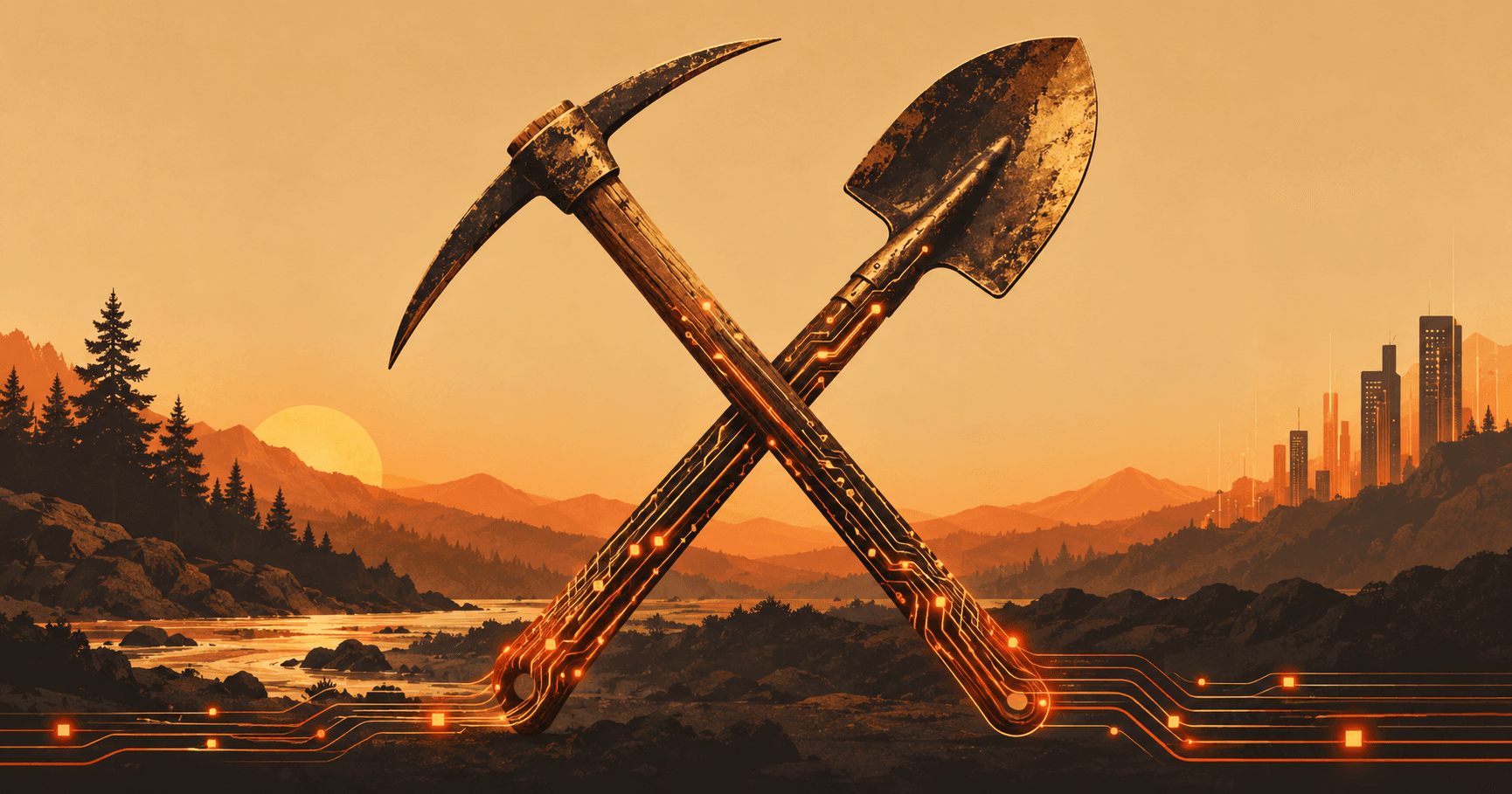
The Shovel Sellers of the AI Gold Rush
What an 1849 gold rush hustler has in common with an AI company built by three people I've known since college
In 1849, the real fortune wasn't in the gold, it was in the shovels. In 2026, the shovel is clean access to the web, built by three people I've known since college.
This post is not sponsored in any way, and is written purely based on my own opinions and observations.
On May 12, 1848, a man ran down Market Street in San Francisco waving a bottle of gold dust over his head and shouting "Gold! Gold from the American River!"
His name was Samuel Brannan. He owned a general store, he published a newspaper, and he had spent the previous week doing something that usually gets left out of the story.
He had heard rumors of gold at Coloma and gone to see for himself. What he found convinced him there was more gold in California than the people already living there could take out in fifty years. So he went back to San Francisco and quietly bought every pick, pan, and shovel in the city.
Then he ran down Market Street.
Pans he had bought for twenty cents sold to arriving miners for fifteen dollars apiece. Brannan became California's first millionaire without mining a single ounce of gold himself.
The Pattern
Brannan was not a fluke. He was the first draft of a pattern that ran for the next twenty years.
Levi Strauss arrived in 1853 selling dry goods to miners, and two decades later patented the riveted work pants that still carry his name. John Studebaker built wheelbarrows in Placerville and rolled the proceeds into a wagon company that eventually built automobiles. Wells Fargo never dug for anything. It moved the money, and it is still moving money today.
The miners were the story, the merchants were the business. Plenty of prospectors did fine and a few got very rich, but the reliable money belonged to whoever sold something every prospector needed, regardless of whether that particular prospector ever found anything.
Which gave us the maxim that has outlived everyone involved: "in a gold rush, sell shovels."
The Rush We Are In Now
Right now, thousands of teams are racing to build AI agents and applications as fast as they can. Most of them will not make it. That is not a knock on them, that is just what a rush looks like from the inside.
So where are the shovels?
The obvious answer is NVIDIA, and the obvious answer is right. Chips and data centers are the picks and pans of this one.
But the 49ers needed more than picks. They needed pants that did not fall apart, wagons that made it over the pass, some idea of where to dig in the first place, banks that would move their gold back east, and supply lines that kept running after the first wave arrived. A rush this size has room for more than one merchant.
The one that caught my attention sits a layer above the chips. It is called Firecrawl, and it was built by University of New Hampshire alumni. As a UNH alum myself, and someone who has known them since school, I have been proudly watching them for years.
What Firecrawl Actually Sells
Something most people do not think about with AI, and I did not think about it either, is that a model is only as good as what it can reach.
Early models were trained on frozen snapshots of the internet. Ask one about something that happened last week and you got a confident answer built out of last year's data. Connecting models to the live web solved that, and immediately created a harder problem.
The web holds most of human knowledge, and it’s also a mess. Pages are cluttered with navigation and ads and cookie banners, sites render themselves with JavaScript after the page loads, PDFs are inconsistent, Rate limits, proxies, and anti-bot systems fight back.
And that is only half of it. An agent does not start with a URL, it starts with a question, which means before it can read anything useful it has to find the right pages at all. Finding and reading are two different jobs. An agent needs both of them to work every time, or it is not much of an agent.
Every team building an AI product hits this wall, and every team that hits it faces the same choice, build and maintain that infrastructure yourself and watch it break constantly, or find someone who already did.
Firecrawl is a single API that handles both sides. Search the web, pull down what it finds, and hand back clean, structured, LLM-ready data an agent can act on. That is the entire pitch. It is not glamorous. It is a shovel, and a map for where to dig.
The scale it has reached says the rest. As of today, the company reports more than 1.25 million developers, over 150,000 companies, 5 billion requests served, and 170,000 stars on GitHub. Zapier, Shopify, Replit, Lovable, and Canva are all customers, along with some of the largest hedge funds in the world.
The Part That Makes Them Brannan
Here is what I find most interesting, and it is the reason the analogy holds up for me rather than just sounding good.
Firecrawl is not what they set out to build. It is the third answer they landed on.
They started with SideGuide, an online learning platform that grew past fifty thousand users and got them into Y Combinator. Then it became Mendable, an AI search product that made its way inside Snap, MongoDB, and DoorDash. That one worked too.
Both times they moved for the same reason. Feeding a model good information meant wrestling the open web into a usable shape, over and over, and the wrestling never got any easier. Every AI company was rebuilding the same broken thing. So rather than patch it one customer at a time, they went upstream and built it once.
That is exactly what Brannan did. He was not a prospector who got lucky. He was a storekeeper and a newspaperman who went and looked at the river himself, understood what was about to happen, and repositioned everything he had before anyone else showed up.
What I Keep Coming Back To
The lesson of 1849 was never "do not mine." Plenty of people mined and did well. It was that the surest position in any rush belongs to whoever solves the problem every single participant has, whether or not that participant ever finds what they came for.
In 1849 that was picks, pants, wagons, and a way to move the money.
In 2026 it is clean access to the web.
I did not write all this because Firecrawl is a good business, though it clearly is. I wrote it because I have spent years watching three peers I have known since school take two real swings that did not turn into this, keep going anyway, and end up building something a large slice of the AI industry now quietly runs on.
Twice they had a company that worked. Twice they followed the problem instead of the product. That is a much harder thing to do than the funding announcements ever make it look.
Firecrawl was founded by Caleb Peffer, Nicolas Silberstein Camara, and Eric Ciarla. Usage figures are current as of August 2026 and are linked to their sources above.
Get new posts by email
No spam, just an email when something new goes up.